

Who likes constructive criticism/ feedback?
Let's be completely honest here, I’m not its biggest fan. As a human being, especially one with anxiety, I am sensitive to hearing about my imperfections.

But first,
Hi, it’s me again!
Thank you for (still) being here after more than 2 weeks of me not blogging at all.
Well, I’ve been still writing - but in my journal instead of on the blogs.
Now I’m back - with a special blog. Because this time, I collaborated with khanhtoilet to write up this blog.
We started with the question, “Is it a problem that we didn’t actually like receiving constructive feedback (except for praises)?”.
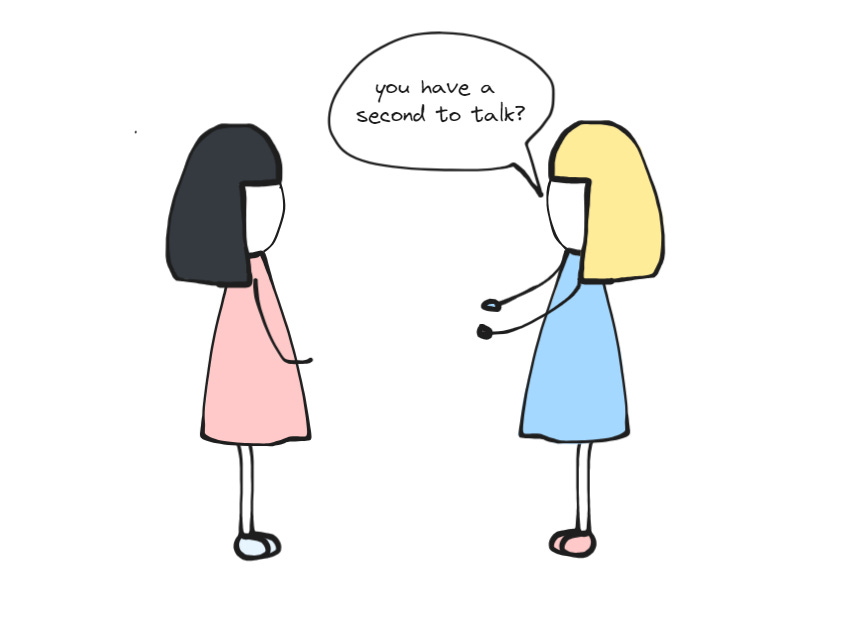
After 2 hours of bouncing ideas with each other and over a week of procrastination, here are my thoughts.
I. Let’s accept that we are human beings.
Psychologists have a lot of theories about why people are so sensitive to hearing about their own imperfections.
One of them is “negativity bias” - the tendency to pay more attention to bad or negative things.
Putting aside all the neuroscientific evidence (as I am not capable of well explaining them), negativity bias highlights the fact that:
in almost every interaction, we are more likely to notice negative things, recall them better, and react more strongly to negative stimuli.
So, is it a problem that we may not like to receive constructive feedback?
Human-ly saying, it is not a problem that we may not like them.
But it could be a problem that we do not take in feedback at all.
II. Constructive feedback does not always focus only on the room for improvement.
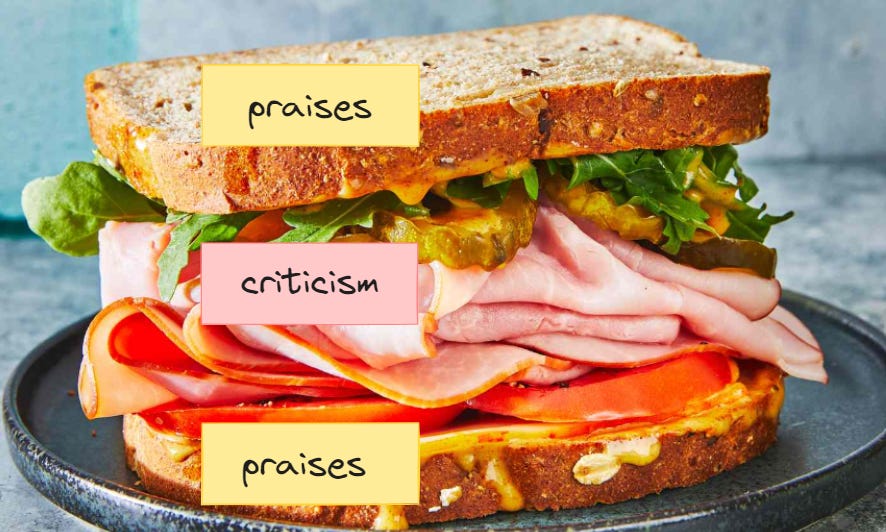
Constructive feedback aims at achieving a positive outcome by providing someone with comments, advice, or suggestions that are useful for their work or their future. They should focus on the work rather than being a personal negative attack against an individual.
It could be either praise or criticism.
BUT…
Even if constructive feedback combines both praise and criticism, we are likely to focus, remember, and react against the criticism rather than praise.
Even if constructive feedback focuses on the work, we are likely to think to ourselves “The work needs improvement because I was not good enough.”
III. To action, or not to action the feedback, is up to the recipient.
In the Facilitation workbook given by my current manager, it said:
“Feedback is actually about information rather than action. Although feedback usually focuses on what should be changed, feedback should not be given with a compulsory requirement to change.
Because at the end of the day, it’s up to the recipient to action or not action the feedback.”
But who am I to ignore the feedback?
What if I fail their expectation?
What if they judge my performance badly?
What if I get demoted, or worse fired?
IV. Take a step back and a deep breath. Learn:
How did you feel?
During my ideas-bouncing session with Khanh, I told em about my own experience where I received some feedback from my senior colleague.
With a person born and breathing with a great level of anxiety, I felt:
Super anxious. “Oh no, I messed up. I did something off the standards. They’d probably think bad about my work ethics now.”
Quite upset and self-blamed. “I was not good enough. I may never be good enough. How could I have done something like this?”
A bit defensive. “Wait, was it that bad that they needed to bring up to my face? I felt like that could be minor and not affecting anyone?”
I felt bad having all of these thoughts. (Although I don’t think we should be.)
But they are inevitable.
And you cannot solve the puzzles without unboxing the pack and throwing all the puzzles onto the surface right?
To reframe the feedback: Why do you think that person decided to give you feedback?
A friend of mine, after knowing the story, told me that: I felt like you are being challenged rather than being criticised, because they know you can do better.
(Or I guess they just said so to make me feel better.)
Then I told Khanh.
“The feeling that I was being challenged upon receiving the feedback was not a bad thing. But would I like to be challenged, or be trusted in my work?”
Here are Khanh’s wisdom words:
I think the right word in your situation could be “to delegate” - because they trust so they challenge. It could be that the way they “delegate” doesn’t speak for itself, but you can reframe it yourself.
Who’s in your corner?
Let’s circle back to my first thought: We are all human beings.
Find someone you trust, someone who will give you a great deal of attention, listening and affirmation.
As a completely normal human, it’s OK to tell them that: “I know they have a point, but receiving such feedback feels awful.” And you probably don’t want a person who agrees with the other person and starts giving you more constructive feedback, not gonna lie.
What’s the most suitable way for you to acknowledge and act on feedback?
Do you need to gather facts to support the feedback as well as your learning journey?
Do you need to discuss further with the feedback giver to make a proper plan?
Do you need to learn how to be more appreciative of the feedback?
Do you need a reminder that one constructive feedback doesn’t determine your working standard and that you could be even better with feedback actioned correctly?
V. The feedback giver is not always right.
If they are more of judging you and personally attacking you as a person, rather than giving constructive feedback, well don’t fight back actually.
I remember seeing a therapist’s video, in which she said:
“If I’m judging my patient for any reason, it tells more about my problems than theirs. And I would have to see a therapist myself.”
That’s all my thoughts dumped on the comeback blog!
Big thanks to khanhtoilet & bao chau & all of my readers for keeping me accountable for writing!
If you are new around here, please hit the button below to become one of my accountability blogging buddy :)
aw trời ưi tự dưng lời em nói lại thành wisdom words trong bài chị Thảo <3 em thấy đoạn hành động đúng ghê, em sẽ tự hỏi bản thân những câu đó khi em nhận feedback, ít nhất là để em trả lời next steps sau khi cho/ nhận feedback